
Cat & Jack Size Chart & Fit Finder
Find the perfect fit for your child the first time. Use our smart interactive size calculator, explore department measurement tables with imperial/metric toggles, and view visual measuring guides backed by Target's 365-day return guarantee.
Interactive Cat & Jack Size Finder
Input your child's age group, height, and weight to instantly receive their recommended Cat & Jack clothing or shoe size.
Fit notes will appear here based on your child's measurements.
Cat & Jack Measurement Tables
Official Target fit benchmarks. Switch tabs to quickly view measurements by department, or toggle units between imperial (in / lb) and metric (cm / kg).
Baby Clothing (Regular Fit)
| Size | Weight (lb) | Length / Height (in) | Typical Age |
|---|---|---|---|
| Preemie | Up to 5.5 lb | Up to 17.5 in | Premature |
| Newborn | 6–8 lb | 18–20 in | 0–1 Month |
| 0–3M | 9–12 lb | 20.5–23.5 in | 0–3 Months |
| 3–6M | 12.5–16 lb | 24–25.5 in | 3–6 Months |
| 6–9M | 16.5–19.5 lb | 26–27.5 in | 6–9 Months |
| 9–12M | 20–23 lb | 28–30.5 in | 9–12 Months |
| 18M | 23.5–26 lb | 31–32.5 in | 12–18 Months |
| 24M | 26.5–28 lb | 33–35.5 in | 18–24 Months |
Toddler Clothing (Tops, Pants & Sets)
Measurements in Inches & Pounds| Size | Height (in) | Weight (lb) | Chest (in) | Waist (in) | Hip (in) |
|---|---|---|---|---|---|
| 12M | 28–30.5" | 20–23 lb | 19" | 19.5" | 19" |
| 18M | 31–32.5" | 23.5–26 lb | 20" | 20" | 20" |
| 2T | 33–35.5" | 26.5–28 lb | 21" | 20.5" | 21" |
| 3T | 36–38.5" | 28.5–32 lb | 22" | 21" | 22" |
| 4T / 4 | 39–43" | 32.5–37 lb | 23" | 21.5" | 23" |
| 5T / 5 | 43.5–45" | 37.5–42 lb | 24" | 22" | 24" |
Cat & Jack Girls Size Chart (Sizes 4 to 18 & Plus)
Height, Chest & Waist in Inches| Alpha Size | Numeric | Height (in) | Weight (lb) | Chest (in) | Waist (in) |
|---|---|---|---|---|---|
| XS | 4 | 40.5–41.5" | 33–38 lb | 23" | 21.5" |
| XS | 5 | 43.5–44.5" | 39–43 lb | 24" | 22" |
| S | 6 | 45.5–46.5" | 44–49 lb | 25" | 22.5" |
| S | 6X | 47–48.5" | 50–54 lb | 26" | 23" |
| M | 7 | 49.5–51" | 55–60 lb | 27" | 23.5" |
| M | 8 | 51.5–53" | 61–68 lb | 27.5" | 24" |
| L | 10 | 54–55.5" | 69–82 lb | 29.5" | 25" |
| L | 12 | 56.5–58" | 83–96 lb | 31" | 26" |
| XL | 14 | 59–60.5" | 97–110 lb | 32.5" | 27" |
| XL | 16 | 61–62.5" | 111–120 lb | 34" | 28.5" |
| XXL | 18 | 63–65" | 121–132 lb | 36" | 30.5" |
Cat & Jack Boys Size Chart (Regular, Slim & Husky)
Height, Weight, Chest & Waist in Inches| Alpha Size | Numeric | Height (in) | Weight (lb) | Chest (in) | Waist (in) | Hip (in) |
|---|---|---|---|---|---|---|
| XS | 4 | 40–42" | 33–39 lb | 23" | 21.5" | 23" |
| XS | 5 | 43–45" | 40–44 lb | 24" | 22" | 24" |
| S | 6 | 45–47" | 45–49 lb | 25" | 22.5" | 25" |
| S | 7 | 47–49" | 50–55 lb | 25.5" | 23" | 26" |
| M | 8 | 50–52" | 56–67 lb | 26" | 24" | 28" |
| M | 10 | 53–55" | 68–80 lb | 27" | 25" | 29" |
| L | 12 | 56–58" | 81–95 lb | 28" | 26" | 30" |
| L | 14 | 59–62" | 96–108 lb | 30" | 28" | 32" |
| XL | 16 | 62–65" | 109–120 lb | 32" | 30" | 34" |
| XXL | 18 | 65–67" | 121–132 lb | 33.5" | 31" | 35.5" |
Cat & Jack Shoe Size Chart & Conversion Guide
Toddler & Youth (Inches & Centimeters)| Department | US Size | Approx. Age | Foot Length (in) | Foot Length (cm) |
|---|---|---|---|---|
| Toddler | 4T / 5T | 9–15 Months | 4.75–5.125" | 12.1–13.0 cm |
| Toddler | 6T / 7T | 15–24 Months | 5.5–5.75" | 14.0–14.6 cm |
| Toddler | 8T / 9T | 2–3 Years | 6.125–6.5" | 15.6–16.5 cm |
| Toddler | 10T / 11T / 12T | 3–5 Years | 6.75–7.5" | 17.1–19.1 cm |
| Kids / Youth | 13 Youth | 5–6 Years | 7.75" | 19.7 cm |
| Kids / Youth | 1 Youth / 2 Youth | 6–7.5 Years | 8.125–8.5" | 20.6–21.6 cm |
| Kids / Youth | 3 Youth / 4 Youth | 7.5–9 Years | 8.75–9.125" | 22.2–23.2 cm |
| Kids / Youth | 5 Youth / 6 Youth | 9–11 Years | 9.5–9.75" | 24.1–24.8 cm |
| Kids / Youth | 7 Youth | 11–12+ Years | 10.0" | 25.4 cm |
Visual Guide: How to Measure Children's Sizes
Accurate measurements take less than two minutes and prevent return trips. Follow these 4 essential measuring checkpoints.
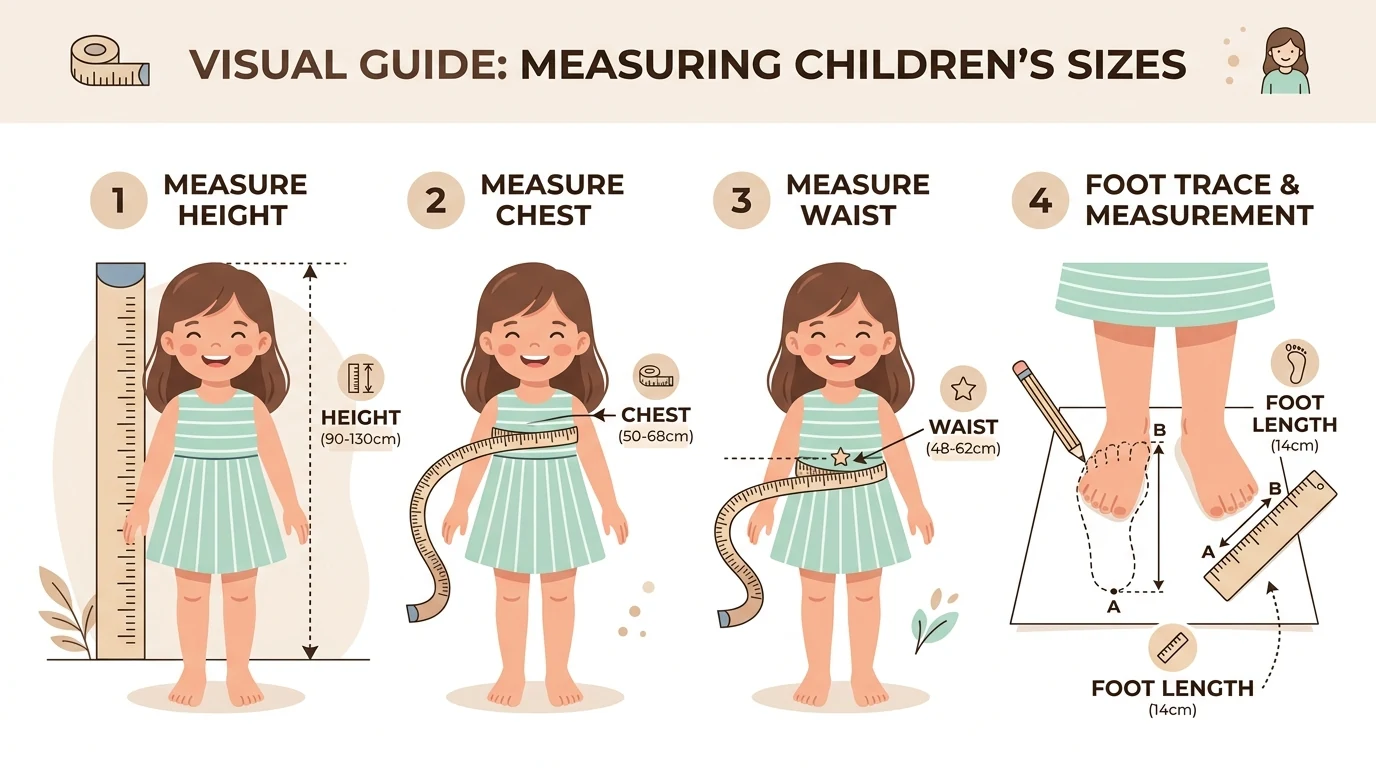
Measure Height
Have your child stand barefoot with heels flat against a bare wall. Place a flat book on top of their head and mark the wall lightly, then measure from the floor to the mark.
Measure Chest
Wrap a flexible measuring tape comfortably around the fullest part of their chest, directly beneath the armpits. Keep the tape level across the shoulder blades.
Measure Waist
Measure around the natural narrowest point of their waistline, where their elastic play pants naturally rest. Keep one finger between the tape and skin for a relaxed fit.
Trace Feet for Shoes
Place a piece of paper on a hard floor. Have your child stand with full weight on the paper while wearing socks, trace heel to longest toe, and measure the distance in inches.
Solving the Top 2 Parent Sizing Dilemmas
Clear side-by-side answers to the most common fit questions parents encounter when shopping Cat & Jack.
24 Months vs. 2T: What Is the Difference?
While both sizes accommodate children weighing around 26.5 to 28 pounds, their tailoring addresses completely different developmental stages:
24 Months (Baby)
Diaper Proportion: Cut wider in the seat with extra room for bulky diapers. Features snap-crotch openings for quick changing on bodysuits and rompers.
Toddler 2T
Potty Training: Cut leaner and taller through the torso and inseam for walking toddlers. Features elasticized pull-on waistbands without bottom snaps.
Slim, Regular & Husky: Which Cut to Pick?
Cat & Jack reinforced jeans and school uniform chinos offer 3 distinct waist-to-hip proportions to prevent sagging or tight waistbands:
Slim & Regular
Slim: 1.5" to 2" narrower through the waist and hips for leaner builds.
Adjustable Tabs: Both cuts include internal hidden buttonhole elastic tabs to customize waist tension.
Husky
Husky Cut: Adds 2" to 3" of additional ease through the waist, seat, and thighs while maintaining proportional inseam lengths so pants don't drag on the floor.
Frequently Asked Questions: Sizing & Fit
Direct guidance on sizing up, shrinkage, footwear thumb rules, and Target's 365-day fit guarantee.
Does Cat & Jack run small, true to size, or big?
Cat & Jack clothing generally runs true to size with a comfortable, generous play-ready cut. Tops and everyday knit tees track reliably to child height benchmarks. If your child is between sizes or sits at the highest weight limit of a bracket, sizing up one size is recommended for fleece-lined hoodies, winter jackets, and woven button-down shirts.
Do Cat & Jack shoes run big or small?
Cat & Jack shoes typically fit true to size. Sandals with contoured footbeds and adjustable hook-and-loop straps accommodate standard to slightly wider feet easily. For rain boots or snow boots, consider sizing up a half or full size to leave room for thick thermal socks. Always leave about a thumb's width (0.5 inches) of space at the toe.
Do Cat & Jack cotton clothes shrink after washing?
Most Cat & Jack cotton basics are pre-washed to minimize shrinkage. However, pure 100% cotton garments may experience 2% to 4% natural shrinkage if dried on high heat. To preserve length and fit, wash in cold water and tumble dry on low heat.
How do I use the Cat & Jack size chart for girls and boys?
To find the best fit on the Cat & Jack size chart for girls or boys, prioritize your child's standing height first, followed by chest and waist circumference. For girls' dresses and tops, chest measurement is critical; for boys' jeans, pants, and shorts, refer to the waist and inseam tables. If measurements fall between two numeric sizes, size up for woven items or choose the smaller size for stretchy ribbed knits.
What is the difference between Cat & Jack Regular, Slim, and Husky sizes?
Cat & Jack offers dedicated Slim and Husky cuts for boys (and Plus sizing for girls). Slim cuts reduce the waist and hip circumference by approximately 1.5 to 2 inches while keeping the full standard leg length. Husky cuts add 2 to 3 inches through the waist, hip, and thigh for broader builds. Both cuts still include Target's signature hidden interior buttonhole elastic adjusters for a tailored waist.
What if an item does not fit my child? Can I exchange it?
Yes. Cat & Jack products are backed by Target's 1-year return policy for owned brands. If clothes or shoes don't fit or wear out within 365 days of purchase, you can return them with proof of purchase (such as a paper receipt or Target Circle transaction barcode) for a full refund or exchange.